
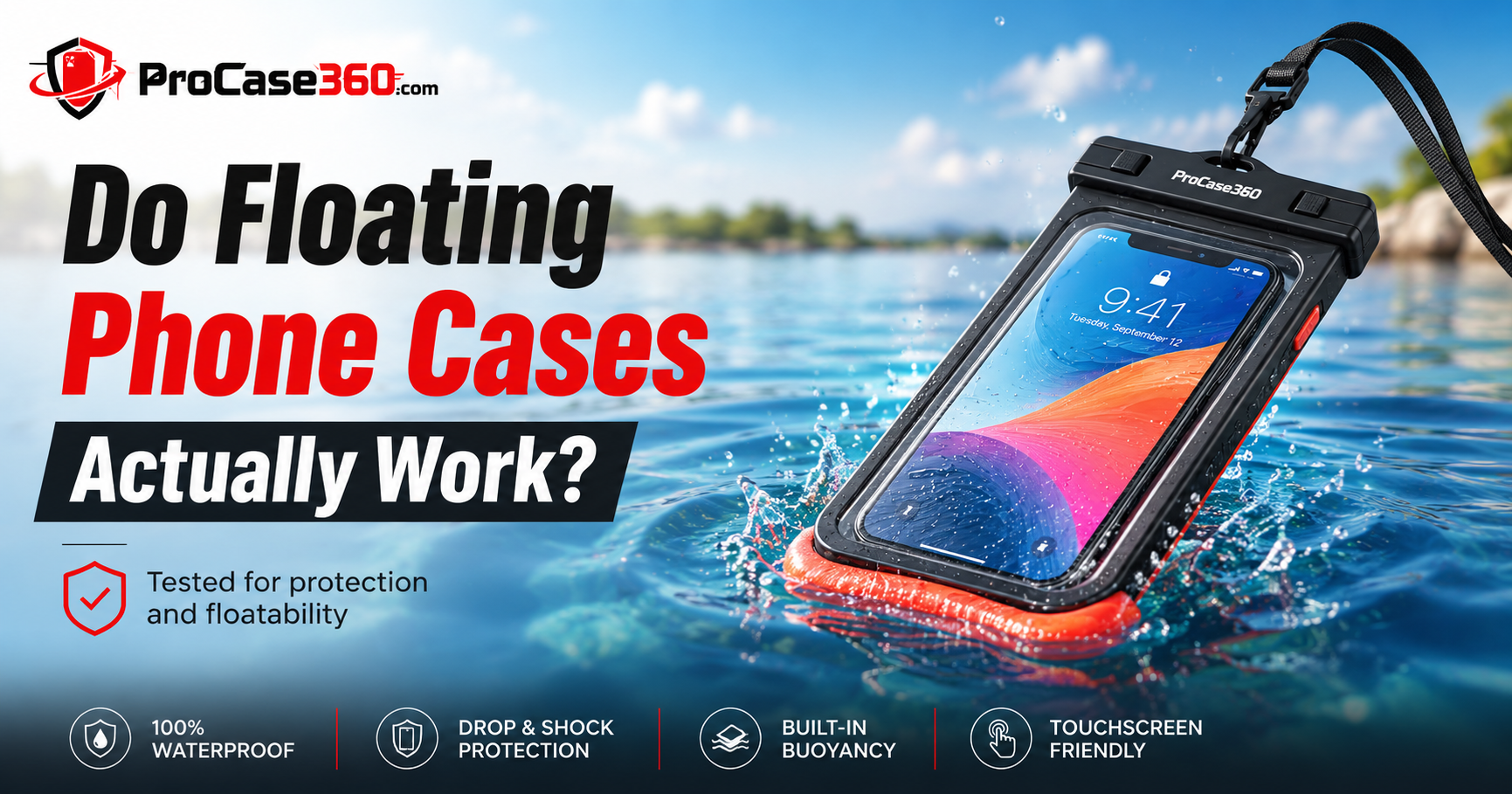
Do Floating Phone Cases Actually Work?
A normal waterproof case keeps water out — right up until it sinks to the bottom of the lake with your phone inside. Here’s the physics behind cases that float, and how to tell a real one from a gimmick.
Key Takeaways
- Yes — a properly built floating case keeps your phone on the surface because it adds sealed, air-filled volume that makes the whole package lighter than the water it pushes aside.
- “Floating” and “waterproof” are two different jobs. The best cases do both; some only do one.
- Look for a stated IP rating and a buoyancy claim, and always test a new case before you trust it on open water.
The short answer
Yes, floating phone cases work — and the good ones work remarkably well. Drop one in a pool and it bobs right back to the surface, usually screen-up, instead of disappearing into the deep end. The catch is that “floating case” is a category with a wide quality range, and a handful of products lean on the word without the engineering to back it up. Once you understand why they float, spotting the real ones takes about ten seconds.
Why your phone sinks (and a case doesn’t)
It comes down to one idea from a very old bathtub: buoyancy. Anything placed in water is pushed up by a force equal to the weight of the water it displaces. If an object weighs more than the water it shoves out of the way, it sinks. If it weighs less, it floats. A bare phone is dense — glass, metal, and a battery packed into a small volume — so it displaces only a little water and sinks fast.
A floating case wraps that same dense phone in a much larger, mostly hollow shell. The case-and-phone package now displaces a lot more water while barely adding weight, so its average density drops below water’s. The result: the buoyant force wins, and the whole thing rides on top.
How floating cases pull it off
There are three common ways manufacturers add that life-saving buoyancy, and the best floating cases combine them:
1. Sealed air chambers
Hollow, watertight pockets built into the frame trap a fixed volume of air. This is the most weight-efficient approach — air is essentially free buoyancy — but it only works if those chambers stay sealed, which puts the spotlight on gasket and weld quality.
2. Closed-cell foam
Some designs pack lightweight closed-cell foam (the kind that doesn’t soak up water) into the shell or a surrounding bumper. Foam is more forgiving than a single air chamber: a small puncture won’t flood it, so buoyancy degrades gracefully rather than failing all at once.
3. Low-density materials and a bigger footprint
Thicker walls, raised bumpers, and buoyant polymers all add displaced volume. That’s also why floating cases are usually chunkier than a slim everyday case — the bulk is the feature.
Why screen-up matters. Good floating cases distribute that buoyant volume so the case self-rights and floats display-side up. That’s not just for looks — a screen you can see is a screen you can spot and grab before a wave carries it off.
Floating case vs. pouch vs. strap
“Keeping your phone afloat” can be solved a few different ways, and they’re not equal. Here’s how the common approaches stack up.
| Approach | Floats? | Water protection | Everyday use | Best for |
|---|---|---|---|---|
| Floating waterproof case | Yes | Sealed (IP-rated) | Bulky but usable | Boating, kayaking, fishing |
| Floating dry pouch | Yes | Sealed (IP-rated) | Pull phone out to use | Universal fit, budget, travel |
| Floating wrist strap / lanyard | Yes (the strap floats) | None on its own | Add-on to any case | Quick insurance, paddleboards |
| Standard waterproof case | No — sinks | Sealed (IP-rated) | Slim, daily-driver | Rain, splashes, showers |
The takeaway: a waterproof case and a floating case are answering different questions. Waterproofing asks “will water get in?” Buoyancy asks “will I ever see it again?” On open water you want both — which is exactly what our floating phone cases and waterproof pouches are built to do.
How to trust one before you rely on it
Before you take any new case out on the water with your phone inside, run this quick gut-check:
- Read the rating, not the adjective. A real product states an IP rating (like IP68) for water sealing — not just the word “waterproof.” If you’re unsure what those numbers mean, our guide on what IP ratings actually mean breaks it down.
- Confirm the buoyancy claim. Waterproof does not imply floating. Look for an explicit “floats” claim and, ideally, the device sizes it’s rated to keep afloat.
- Do a dry-run float test. Seal a folded paper towel inside and float the empty case in a sink for a few minutes. It should ride high and stay dry inside. Only then graduate to your phone in shallow, safe water.
- Don’t overstuff it. Buoyancy is rated for a device size. Cramming a phone-plus-thick-second-case can sink the whole thing.
- Add a floating lanyard anyway. Belt and suspenders. A buck of insurance against a $1,000 phone is a good trade.
Start with a true floating case
Browse our flagship floating line built with sealed buoyancy chambers and IP-rated seals — or compare options across the major marketplaces.
Who actually needs one
If your phone never goes near deep water, a slim waterproof case is plenty. A floating case earns its bulk the moment “deep water” enters the picture: anglers leaning over the side of a boat, kayakers and paddleboarders, anyone shooting video off a jet ski, parents at the pool, and beachgoers fighting shore break. In all of those, the failure mode isn’t a splash — it’s a drop into water too deep or too murky to reach. That’s the exact scenario buoyancy is designed for.
One honest limitation. A floating case buys you time and visibility, not invincibility. In a fast current or surf, even a floating phone can drift. Pair it with a leash, and don’t go for a swim with it clipped to nothing.
Frequently Asked Questions
Will a floating case keep my phone dry too?
Only if it carries a water-sealing rating. Many floating cases are also waterproof (look for IP67/IP68), but a few floating add-ons — like a foam lanyard — keep the phone up without sealing it. Always check for a stated IP rating if submersion is possible.
Do floating cases work for all phone sizes?
Buoyancy is tuned to a device-size range. A case rated for a large phone has more lift; using a case below its size range is fine, but exceeding it — or adding bulky inserts — can overcome the buoyancy and sink it.
Can I still use the touchscreen and camera?
Yes. Quality floating cases use clear membranes over the screen and camera so you can shoot and tap while sealed. Touch sensitivity can dip slightly through the film, and screens generally won’t respond underwater.
How long will it stay afloat?
Indefinitely, as long as the seals and air chambers stay intact. Buoyancy isn’t a timer — it only fails if water gets into the chambers, which is why seal quality and the occasional dry-run test matter.
Affiliate disclosure: Some links in this article — including those to Amazon, AliExpress and eBay — are affiliate links. If you buy through them we may earn a small commission at no extra cost to you. We only recommend gear we’d be comfortable using ourselves.


![hitfine Underwater Case Only for iPhone Series,Diving Phone Case [Operated Underwater][98FT/30M] Snorkeling Photo Video,Waterproof Case for iPhone/13/Pro/Pro Max/Mini/12/11/XR/XS/MAX/8/Plus/SE Black](https://m.media-amazon.com/images/I/51cEd-+pObL._SS100_.jpg)